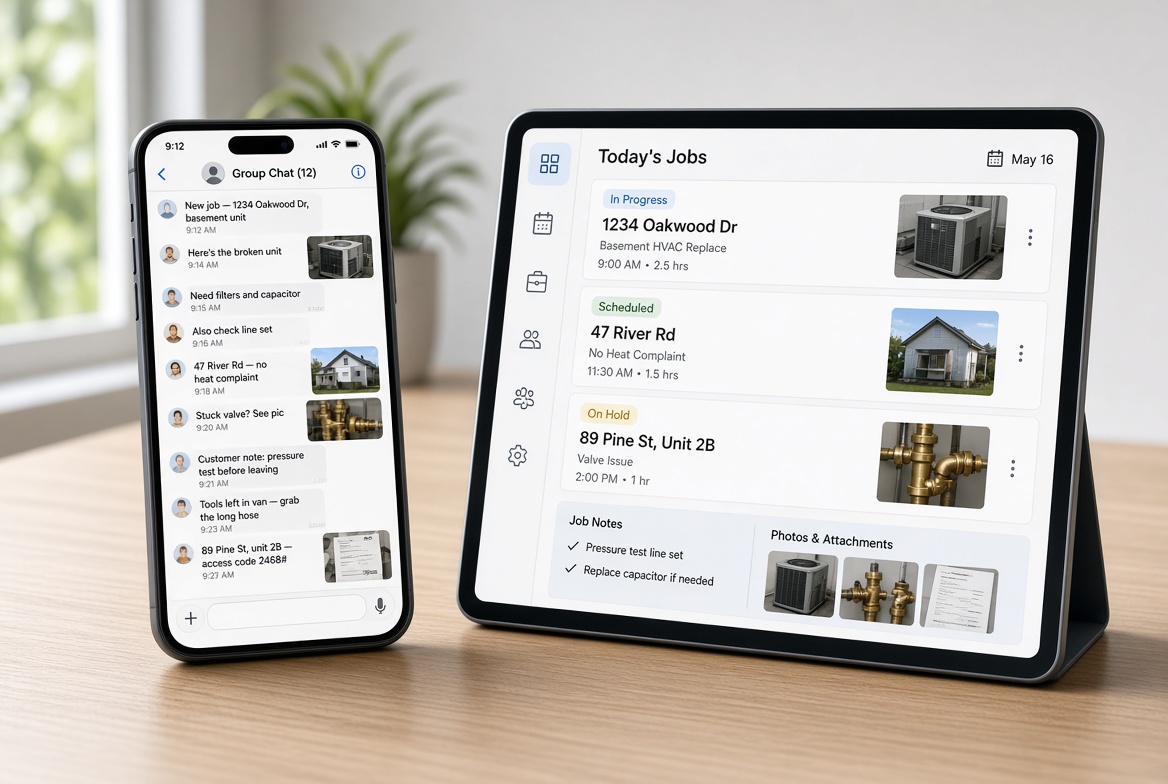
The Hidden Cost of Job Details in Texts
Most service businesses run on text threads. That is the problem.
Open your phone right now. How many group chats or long text chains hold the real details of your jobs?
Customer address buried three messages up. Special instructions sent only to the tech who already left the shop. A photo of the broken unit that no one else can find later. Notes about parts that were ordered but never written down anywhere permanent.
This is normal for plumbing, HVAC, landscaping, cleaning, and restoration companies across Tampa Bay and the rest of Florida. It feels fast. It feels flexible. And it quietly costs you money every single week.
The cost is not dramatic. It shows up as delayed jobs, callbacks, wrong parts, frustrated customers, and crews that spend the first twenty minutes of every day trying to reconstruct what was decided the night before.
Where the real money disappears
When job details live only in text threads, three expensive things happen.
- Information gets lost or misread. A tech sees “rear unit needs new capacitor” but misses the follow-up that said the customer prefers the quieter model. The wrong part goes out. The second trip is pure loss.
- Context never travels with the job. The office knows the customer had a previous complaint about billing. The field tech does not. The conversation starts on the wrong foot and a potential referral turns into a one-star review.
- You cannot look back later. When a warranty claim comes in six months down the road, no one can reconstruct what was actually done. The thread is gone or buried under hundreds of newer messages.
A Tampa HVAC company I worked with tracked this for one month. They found that 18 percent of their callbacks traced back to missing or incomplete information that had lived only in group texts. Each of those callbacks cost them the tech’s time, fuel, and a free part. The monthly total was more than the cost of a simple shared job system.
Why text threads feel safer than they are
Owners often say, “Everyone is already on their phones. Why add another tool?”
The answer is simple: phones are great for conversation. They are terrible as a system of record.
A text thread has no structure. There is no required fields. There is no single place that holds the current status, the customer notes, the parts list, and the photos. When someone new joins the job, they have to scroll and guess.
Once you have more than one crew or more than a handful of open jobs, the thread becomes noise. Important messages get buried. People start private side chats. The office spends part of every day chasing updates that should have been visible in one glance.
A practical diagnostic you can run this week
Pull up the last ten completed jobs. For each one, answer these questions:
- Could a new tech who had never seen the job walk in and know exactly what was expected without asking anyone?
- Where are the photos and notes stored right now? Can you find them in under thirty seconds?
- If the customer called tomorrow with a question about what was done, how long would it take to give an accurate answer?
- How many times did someone have to re-ask for the address, gate code, or special instructions?
If most of the answers are “no” or “I would have to dig,” the text-thread system is already costing you.
What changes when job details have a home
The fix does not require a massive software overhaul. It starts with one simple rule: every active job has a single place that holds the current details.
That place can be a lightweight job board, a shared form that creates a clean record, or even a well-structured internal page. The tool matters less than the discipline.
When details live in one place:
- Techs stop guessing and start the job ready.
- Office staff can answer customer questions without calling the field.
- Parts and special notes travel with the job instead of depending on memory.
- Callbacks drop because less information falls through the cracks.
One Tampa Bay landscaping company made this shift for their install crews. They stopped sending job details by text and started using a simple shared job view. In six weeks their average job start time improved by twelve minutes and their “we need more info” messages almost disappeared. The crews liked it because they spent less time clarifying and more time working.
Start with the highest-friction process
You do not need to fix everything at once. Pick the process that creates the most daily friction.
For many service businesses that process is the handoff from office to field. The office takes the call or the online request. They gather the details. Then those details get pasted into a text or a group chat. That is the moment the information starts to degrade.
Replace that single step first. Capture the details once in a structured place. Let the crew pull from that place instead of a text thread. Keep the humans in the loop for judgment calls, but stop asking the text thread to act as your permanent record.
The quiet advantage
Companies that keep job details clean do not look flashy. They just make fewer expensive mistakes. Their crews show up prepared. Their customers feel like the company has its act together. Referrals come more easily because the work feels reliable.
In a market like Tampa Bay, where many service companies still run on group texts and sticky notes, that reliability becomes a real competitive edge. Customers notice when your team does not have to call the office three times during a single visit.
The businesses that grow without adding chaos are usually the ones that stopped letting critical job information live only in disappearing text threads.
If your current system still relies on long chains of messages to carry the details that keep jobs profitable, the next useful step is rarely a full redesign. It is giving those details a permanent, shared home so the whole team can see the same picture.
Are the calls getting away from you?
I work with Tampa HVAC and plumbing companies that already run at least 3 trucks. Call or text me.