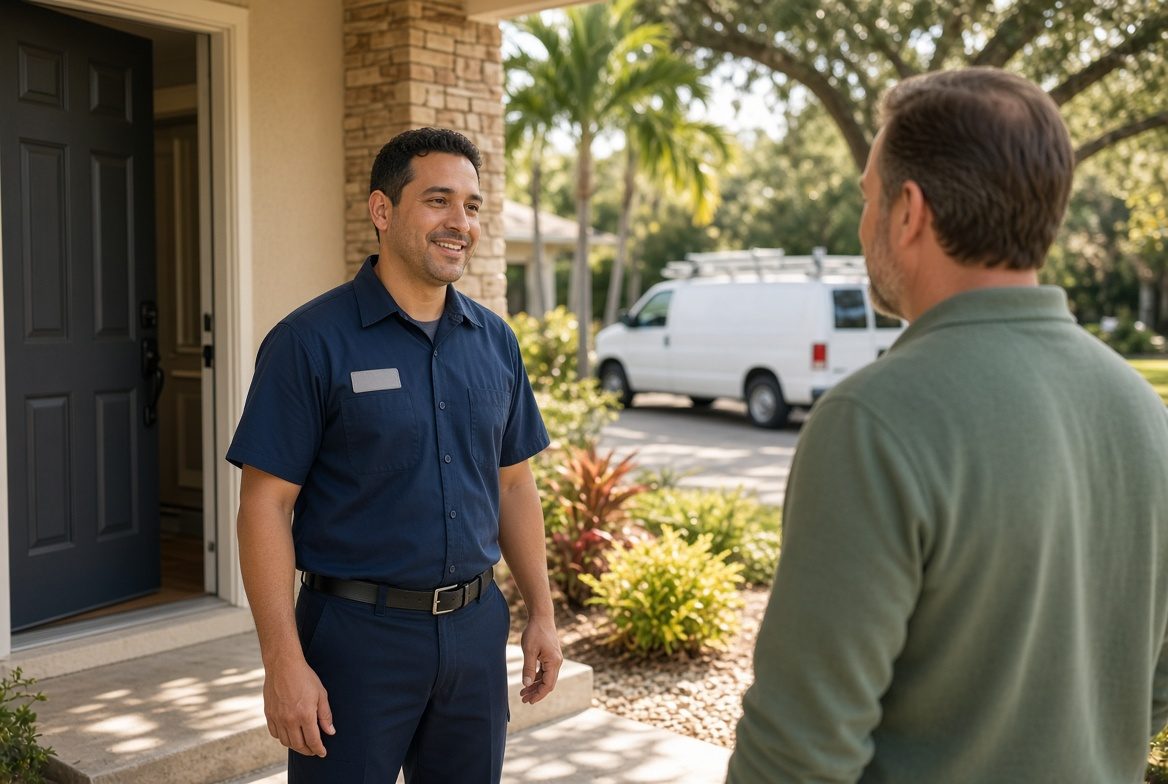
Name the Tech Before They Arrive
A booked job is not a locked job. Homeowners in Tampa Bay cancel, shop around, or stand in the driveway uneasy when they have no idea who is about to knock.
Naming the tech, the arrival window, and the company truck before that knock is a small habit with a big payoff. More jobs stay on the calendar. Fewer “who is this?” texts land while you are on a roof. Neighbors notice that you run a tighter crew than the bigger shop down the road.
Why a nameless confirmation feels risky
Your office sees a calendar block. The homeowner sees a stranger arriving at the house while kids are home, a dog is loose, or they are leaving for work.
A text that only says “we will be there Thursday morning” does not answer the questions that cause cancellations:
- Who is coming?
- What do they look like, roughly?
- What vehicle should I watch for?
- Will I get a heads-up when they are close?
When those answers are missing, people keep a second company on standby. That second company often wins the job you thought you already had.
What this costs a small crew
Take a two-truck HVAC shop in Pinellas County at the end of a hot week. Four Thursday morning slots look full. Two of those homeowners never got a name. One reschedules after a vague “morning” window. One lets another company in because that company texted a tech photo and an ETA.
You did not lose those jobs on the website. You lost them after the booking, in the quiet gap between “you’re on the schedule” and “someone is in my driveway.”
That gap is expensive. The truck is already staged. The parts are on the shelf. The open slot is too late to fill with a real job. You paid for marketing to get a lead that your own confirmation process then made easy to abandon.
A simple 5-part arrival message
You do not need a large platform. You need one message that goes out the afternoon before, plus a short “on the way” note the next day. Keep it consistent so the office does not invent a new version every time.
- Tech name. First name is enough. “Carlos from Gulf Breeze Cooling” beats “our technician.”
- Arrival window. Two hours is workable. “Sometime Thursday” is not.
- Vehicle cue. White van, door magnets, or a unit number. People look out the window before they open the door.
- Job reminder. One line that matches what they booked. “AC tune-up and capacitor check,” not “service call.”
- Easy reply. “Reply 1 to confirm, 2 to reschedule.” Make the next step a tap, not a phone tree.
If you already send a confirmation, add the name and the vehicle. That single change does more than a prettier template.
How a Tampa restoration crew used this
A water-mitigation company covering Hillsborough and Pasco used to send one booking email from a shared inbox. It listed the date and a six-hour window. Techs showed up in unmarked trucks because the wraps were “on order.”
Homeowners called the owner at night asking if the person in the driveway was really with the company. Two jobs a week turned into arguments at the door. A few canceled after seeing an unknown van on the camera.
They changed three things. The office assigned a named tech the day before, not the morning of. The text included the tech’s first name, a two-hour window, and “white transit van with blue magnets.” When the tech left the last job, a short “on my way, 20 minutes” note went out.
Doorstep confusion dropped. Same-day cancellations fell. The owner stopped fielding identity questions while standing in wet living rooms. Referrals improved because the visit felt planned instead of improvised.
A quick diagnostic for your current confirmations
Pull the last 10 booking texts or emails you actually sent. Score each one. If you miss three or more items, ready customers are still guessing.
- Does the message name a real person, not “our team”?
- Is the window two hours or less, with a start and end?
- Can the homeowner picture the vehicle in one sentence?
- Does it restate the job in plain language?
- Is there a one-tap way to confirm or move the slot?
- Do you send a second note when the tech is truly on the way?
- If the tech changes, does the homeowner hear that before the truck turns onto the street?
Item 7 matters more than people admit. A last-minute swap with no notice feels like bait and switch, even when it is just a sick day.
Rules that keep this from becoming more chaos
Naming the tech only works if the schedule is real. If you assign “Mike” and send Luis because Mike ran long, you taught the customer that your texts cannot be trusted.
Use these operating rules so the promise matches the driveway:
- Assign the tech the afternoon before, after the day’s overruns are known.
- If the name changes, send the new name before the old window starts.
- Keep one person responsible for the pre-arrival text. Shared inboxes bury it.
- Do not promise a 30-minute window you cannot keep. A honest two-hour window beats a broken 30-minute one.
- Save gate codes, pets, and parking notes on the job, then include the ones the tech needs in the same thread.
That last point stops the “can you move your car” call that blows the window you just promised.
What to fix before you buy another tool
Most crews already have texts, a calendar, and a phone. The leak is not a missing app. It is an unnamed arrival.
Start with a written template and a daily trigger: every assigned job for tomorrow gets the 5-part message before the office closes. Track two numbers for two weeks. Same-day cancellations. “Who is this?” calls after 4 p.m.
If both drop, the habit is working. If they do not, the problem is usually late assignments or windows that were fiction. Fix those before you shop for software.
Make arrival feel as planned as the booking
Local service work is personal. Someone is entering a house, a yard, or a small shop. The companies that feel safe at the door keep more of the jobs they already won.
A focused system helps here more than a louder website. That can be a cleaner booking flow that captures the window and the assigned tech, a simple job record the office and field both see, or an automatic pre-arrival text that still leaves a human in charge of last-minute swaps. The goal is the same. The homeowner should know who is coming, when they are coming, and what to watch for, without calling you in the middle of another job.
Are the calls getting away from you?
I work with Tampa HVAC and plumbing companies that already run at least 3 trucks. Call or text me.