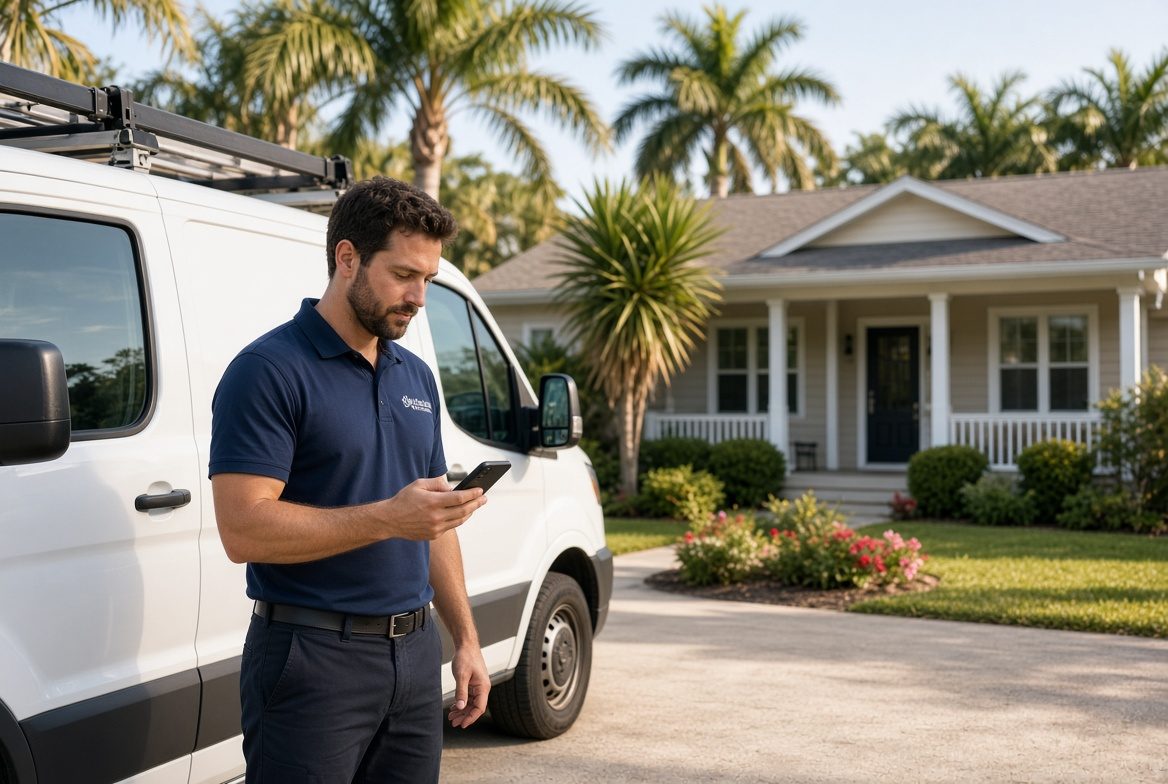
On-My-Way Texts Cut Midday Phone Tag
Mid-morning in a Tampa HVAC shop, the office phone does not stop. The calls are not all new jobs. Three customers want to know if the tech is close.
The tech is on a roof in Brandon. The office is guessing from the last text. Every "are they on the way" call pulls someone off dispatch and stretches the next arrival even more.
A short on-my-way text sounds small. For a local crew it is the difference between a calm route and a day spent apologizing.
The hidden cost of arrival phone tag
Homeowners are not being difficult. They took time off work. They locked the dog up. They are watching the clock because the last company left them waiting with no update.
When nobody tells them the truck is close, they call. Then they call again. The office answers, puts them on hold, texts the tech, waits, and calls back. That loop can eat 8 to 12 minutes per job.
On a six-stop day, that is an hour of talk that does not book work, finish work, or collect payment. It also makes the next customer wait, which starts the same loop all over again.
The damage shows up in three places:
- Office staff who cannot finish quotes because they are fielding status calls
- Techs who stop what they are doing to answer "how much longer" texts
- Customers who feel ignored even when you are doing good work
None of that looks like a missed lead in your ads report. It still costs you jobs, reviews, and the next referral.
Why "we will call when we are close" fails
Most owners already know customers want an update. The plan is usually verbal. "Call them when you leave the last house." That plan dies the first time a job runs long.
The tech is under a sink. Hands are wet. The next stop is already late. Calling feels like one more task, so it slips. The customer does not know that. They only know the window you gave them is almost over.
Phone calls also create new problems. The homeowner misses the ring. You leave a voicemail. They call the office. Now three people are in a loop about a truck that is eight minutes away.
A text does the same job with less friction. It lands even if they are in a meeting. It gives them a time they can act on. It keeps the tech on the tools instead of on hold music.
What a good on-my-way message actually says
The message does not need charm. It needs four facts, in plain language, sent when the tech is actually rolling to that address.
- Who is coming (name or truck, not a generic "our team")
- The service they booked (so they know it is the right job)
- A tight arrival window ("about 15 minutes," not "this afternoon")
- What they should do next (gate code, driveway access, or "reply if you need to reschedule")
Keep it short enough to read on a lock screen. One example that works for a Tampa plumber:
"Hi Maria, this is Luis with Bayshore Plumbing. I am heading to 14th Ave for the leaking shutoff. I should be there in about 15 minutes. Reply here if the gate is closed."
That text answers the question they were about to call about. It also gives them a way to save you a wasted trip if plans changed.
What to leave out
Do not send a novel. Do not attach a survey. Do not ask them to download an app in the same message.
Skip vague lines like "your technician is in the area." In Tampa Bay traffic, "in the area" can still mean 40 minutes. Give a number they can plan around.
A Pinellas restoration crew that got its mornings back
A small water-mitigation company in Pinellas County ran two trucks and one office coordinator. After every storm week, the phone became a status line. Homeowners who had packed a bag and left a wet carpet wanted a real arrival time, not another "we are doing our best."
The owner did not buy a full dispatch platform. The rule was simple. When the tech tapped the next job as "en route," a text went out with the tech name, the address line, and a 20-minute window. If the job ran long, a second text moved the window before the customer had to ask.
In the first month they tracked office calls that were only "where are you" questions. Those dropped from about 15 a day to 3 or 4. The coordinator used the recovered time to confirm the next day's drying equipment instead of playing operator. Techs stopped climbing down a ladder to answer the same question.
The work did not get easier. The noise around the work did.
A simple rule set that makes the habit stick
Tools fail when the rule lives in one person's head. Write the rule where the crew can see it, then keep it narrow.
- Send the text when the truck starts moving to that address, not when the day starts.
- Use the same template every time so nobody has to invent wording on a hot driveway.
- If the window slips by more than 20 minutes, send a new time before the customer calls.
- If the customer replies with a change, the office sees it in one thread, not in three group chats.
- Do not mark the job "on the way" as a courtesy at 7 a.m. for a 2 p.m. stop. That trains people to ignore you.
Those five rules are enough. You do not need a 12-step playbook and a kickoff meeting.
Check this on your next full route day
Use this as a quick diagnostic. If you check three or more boxes, arrival phone tag is costing you real time.
- The office takes more than five "are they close" calls before lunch
- Techs get customer texts while they are still finishing the previous job
- Arrival windows on the calendar are two to four hours wide
- Nobody can see whether the on-my-way message was actually sent
- A late job is explained after the customer is already upset
- Reviews mention waiting or poor communication more than the quality of the work
You do not need software to run this check. Sit near the phone for one busy morning and tally the status calls. That number is your baseline.
Measure the change in calls, not in features
Owners often install a notification tool and assume the problem is solved. The only proof that matters is a quieter office and fewer angry greetings at the door.
Track three numbers for two weeks before you change anything, then two weeks after:
- Status-only calls per day
- Jobs where the customer was home and ready when the tech arrived
- Same-week comments about communication, good or bad
If status calls fall and ready-at-the-door jobs rise, the habit is working. If the texts go out but the calls stay high, the message is late, vague, or going to the wrong number.
Fix the message and the timing before you add more tools. An extra dashboard will not save a text that says "on the way" three hours early.
Arrival updates are not a marketing trick. They are a small operating system for the middle of the day. When the website books the job, the calendar holds a real window, and the truck sends a clear "I am close" note, customers stop chasing you. Your crew keeps its hands on the work. That is how a focused booking flow and a simple internal tool remove the chaos without a full software overhaul.
Are the calls getting away from you?
I work with Tampa HVAC and plumbing companies that already run at least 3 trucks. Call or text me.