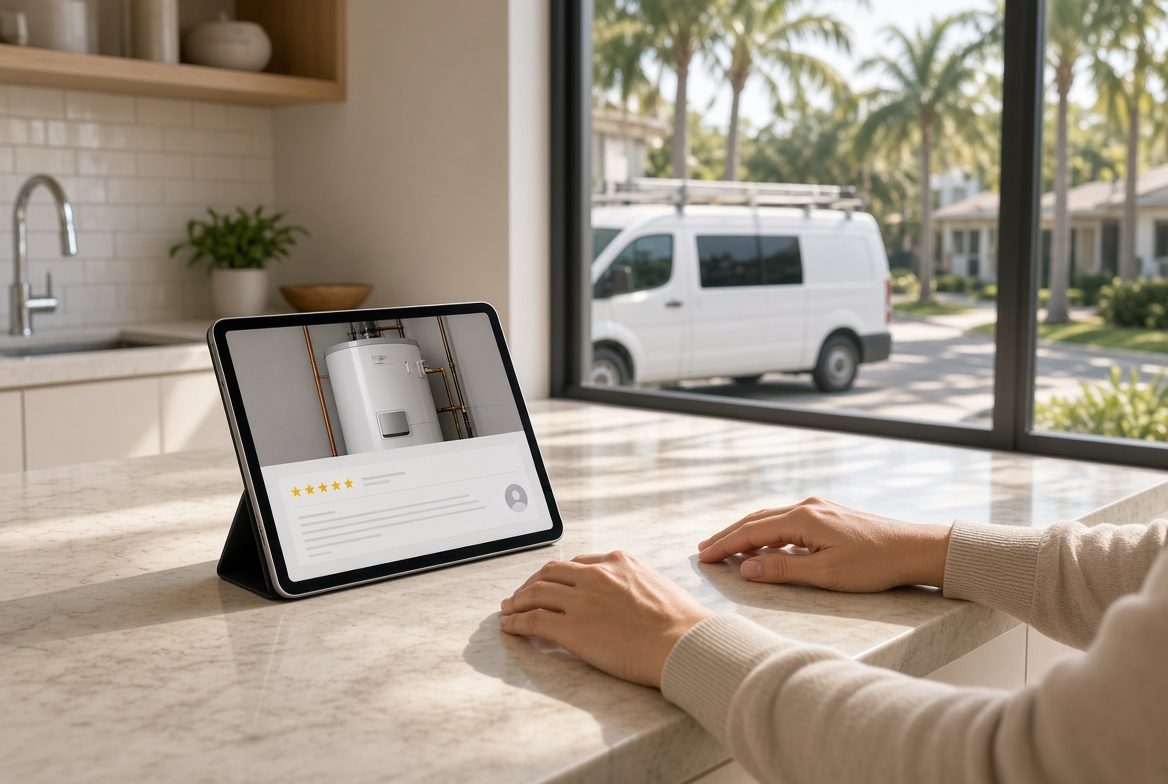
Service Pages Need Proof, Not Adjectives
A homeowner in Brandon does not hire you because your page says you are passionate, professional, or committed to excellence. They hire you when the page proves you do their job, in their area, without surprises.
Most service pages waste that first screen on adjectives. The visitor leaves and calls the company that showed a real water heater, a real review from a nearby zip code, and a clear next step.
What homeowners actually scan for
People do not read service pages like a brochure. They scan for four answers and they do it fast.
Do you handle this exact problem? Do you work where they live? What happens after they reach out? Can they trust you before they give you a phone number?
If those answers are buried under brand language, the page feels empty even when it is long. Length is not proof. Specifics are proof.
Adjectives that waste the first screen
You have seen the usual list. Quality work. Family owned. Affordable prices. Fully licensed. Satisfaction guaranteed.
None of that is false. None of it helps a person decide between you and the next result on their phone. Every competitor uses the same words, so the words stop meaning anything.
The first screen of a service page should not introduce your values. It should name the job, show you have done it, and make the next step obvious.
- Replace "reliable plumbing" with the jobs you actually take this week.
- Replace "serving the Tampa Bay area" with the cities you will drive to tomorrow.
- Replace "contact us today" with book a window or tap to call.
- Replace a stock handshake photo with a photo from a finished job.
If a sentence could sit on any company's site, cut it or attach a fact to it.
Proof that belongs on every service page
Proof is not a testimonial wall at the bottom. Proof is the first thing a visitor can use to say yes.
Put the useful proof next to the service they came to see. A general review on the homepage does not help someone who landed on your drain cleaning page from search.
Use this mix on each core service page
- The job in plain language: "Same-day water heater replacement in Tampa and Brandon."
- What is included, and what is not, in a short list.
- One real photo from that service, not a van in a parking lot.
- A review that names the job type and a nearby city.
- How they start: call, text, or pick a time.
- When you can typically arrive, even if it is a range.
That set does more work than three paragraphs about your story. Save the story for the about page. The service page has a job to do.
A 10-minute page diagnostic
Open your top service page on your phone. Do not use a desktop. Most of your leads will not.
- In five seconds, can you tell what job this page is for?
- Is there a way to call or book without scrolling?
- Does any sentence name a city you actually serve?
- Is there a photo that could only come from your crew?
- Does a review mention this service, not just "great guys"?
- Can a stranger tell what happens after they submit the form?
- Would you send this page to a neighbor who needed the job today?
If you answer no three or more times, the page is costing you calls. A redesign is not the first fix. Swap adjectives for proof and move the action up.
How this looks for a Tampa Bay plumber
Take a plumber in Pinellas who ranks for "water heater replacement near me." The current page opens with a wide photo of a smiling crew and a headline about being the trusted local choice since 2009.
A homeowner in Largo with no hot water does not need 2009. They need to know you replace tank units, whether you cap the old lines, and whether someone can come Thursday.
The stronger page leads with the job. "Water heater replacement in Largo, Clearwater, and St. Petersburg. Tank and tankless. Written scope before we start."
Under that sits a photo of a finished install in a real laundry room, a two-line review from a Seminole customer, and a short list: haul-away included, permits handled on standard swaps, arrival window sent the night before.
Same company. Same trucks. More calls, because the page stopped talking about the company and started talking about the job.
Where proof usually gets stuck
Most owners already have the proof. It lives in the wrong place.
Job photos sit in a tech's camera roll. Reviews sit on Google and never get copied onto the page that ranks. Cities you serve sit in a footer. The booking path sits on a contact page the visitor never opens.
You do not need a new brand. You need a habit of moving finished-job proof onto the pages people actually land on.
- After each good job, pick one photo and one sentence from the customer.
- Drop both onto the matching service page the same week.
- Name the city in the caption or the review line.
- Keep the call button and the short form in the same place on every service page.
Do that for your three highest-search services first. Leave the rest of the site alone until those pages are specific.
Fix the page before you rebuild the site
A new homepage will not save a service page that hides the job. People who search for a service often skip the homepage entirely.
Start with the pages that already get traffic. Make each one answer the job, the area, the proof, and the next step. Then look at speed, mobile tap targets, and whether the form asks for more than you need to book a window.
That is the kind of focused system that turns visits into work. Not a louder slogan. A clearer page that helps a busy owner say yes without guessing.
When those pages are tight, booking gets simpler too. The site stops collecting vague messages and starts collecting jobs you can actually schedule.
Are the calls getting away from you?
I work with Tampa HVAC and plumbing companies that already run at least 3 trucks. Call or text me.