Stop Mixing Emergencies With Booked Routes
A no-cool call comes in at 9:40 a.m. You already have three maintenance stops on the board. You squeeze the emergency into the gap after lunch and tell yourself you will catch up.
You do not catch up. The 1:30 tune-up waits in a hot driveway. The emergency runs long. Two customers now think you cannot keep a promise. That is what happens when emergencies and booked routes share the same calendar lane.
Why one calendar lane breaks both kinds of work
Planned jobs and emergency jobs do not behave the same way. A filter change has a start time, a parts list, and a finish window. A no-cool call has none of that. It expands the moment you open the panel.
When you drop the second kind of work onto the first, you steal time from people who already chose you. You also show up to the emergency rushed, which means missed parts and a return trip.
The cost is not only one late afternoon. It is the review that never gets written, the maintenance plan that does not renew, and the dispatcher who spends the day apologizing.
A Tampa Bay HVAC week that looked busy and still leaked
A two-truck cooling company in Brandon ran one shared schedule through June. Tune-ups, warranty visits, and no-cool calls all sat on the same list. The owner prided himself on saying yes.
By Thursday the pattern was the same. Morning planned stops started late because Tuesday's overflow had spilled. Techs skipped lunch. Office staff called the 3 p.m. customers to push them to Friday. Friday was already full.
They did not hire a third truck. They split the board.
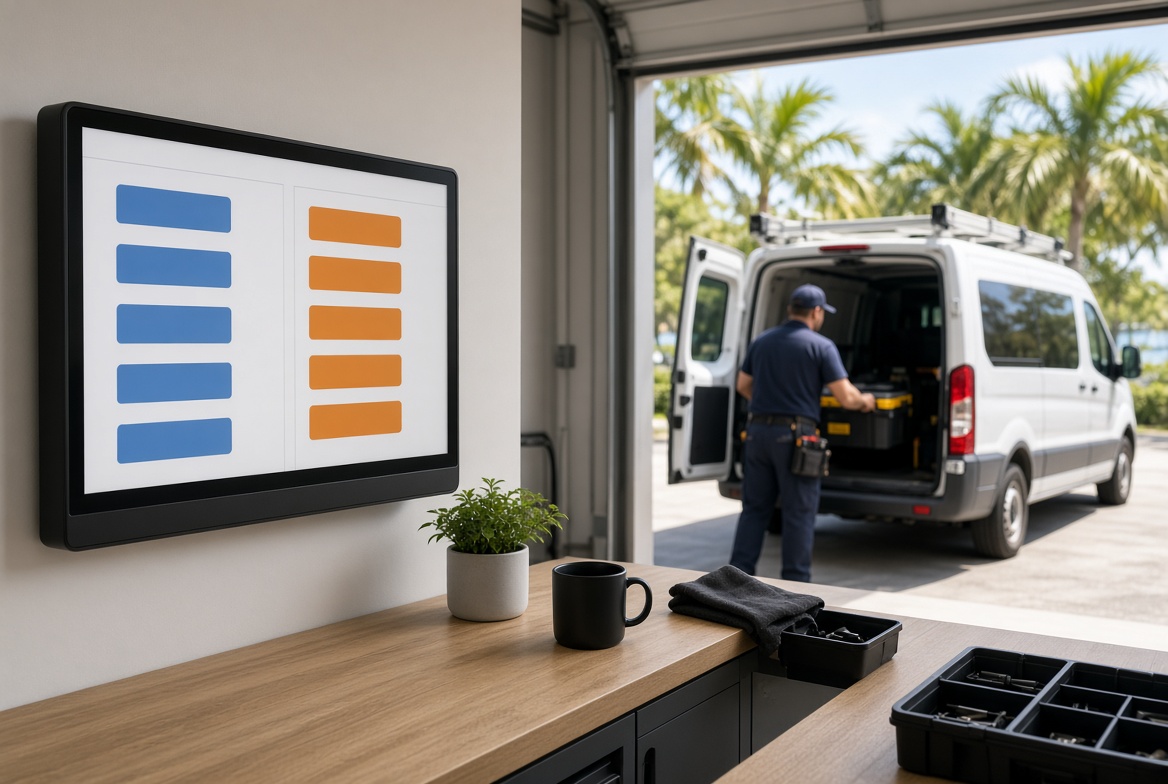
Truck A kept sold maintenance and quoted installs. Truck B held two emergency windows before noon and two after 2 p.m. If those windows stayed empty, Truck B pulled from a short list of flexible visits, not from Truck A's locked stops.
Within two weeks the late-day reschedule texts dropped. Maintenance customers stayed on their original windows. Emergency callers still got a same-day option, just not by wrecking the route that was already promised.
What belongs in each lane
You do not need software with twelve modules to do this. You need a hard rule about which work can land where.
Put this on a card by the phone and treat it as policy, not a suggestion.
- Locked lane: sold visits with a customer-facing window, installs with materials staged, warranty work with a set arrival.
- Flex lane: true emergencies, same-day diagnostics, and a small backup list of visits the customer already agreed can move.
- Do not mix: never drag a locked stop to make room for a new call without offering that customer a new window first.
- Empty flex time: if an emergency window is still open at 11 a.m., fill it from the backup list or use it for quotes and callbacks. Do not raid the locked lane.
If your trade is landscaping, cleaning, or restoration, the labels change and the rule does not. Storm blowdowns, last-minute move-out cleans, and water-loss calls are flex work. Weekly mows, contracted cleans, and scheduled rebuild days are locked work.
A 20-minute diagnostic for your current board
Open yesterday's schedule and mark each stop. You are looking for collisions, not blame.
- How many locked visits moved because a new call came in?
- How many customers got a "running behind" text after 2 p.m.?
- How many emergency jobs started without the right part because the tech was squeezed between two planned stops?
- How many planned jobs were finished in a rush so the next emergency could start?
- Who had permission to break a window, and was that person the owner every time?
If you marked two or more items, you do not have a staffing problem first. You have a lane problem. Adding another tech onto the same mixed board will copy the mess onto a second truck.
How to split the board this week
Start with the next five working days, not a full season rebuild.
First, decide how many emergency windows you can truly cover with the crew you have. One truck might hold two. Two trucks might hold four. Write the number down. That number is your yes budget for same-day work.
Second, protect the locked lane in public. When a customer books a tune-up or a weekly service, give a real window and keep it. The office should see that window as taken, the same way a dentist chair is taken.
Third, give the person who answers the phone a script that matches the board.
- If a locked window is open, offer it.
- If only a flex window is open, say so: "We can do a same-day diagnostic at 11 or 3. The full repair may land tomorrow if we need a part."
- If both lanes are full, take the job for the next open flex slot. Do not invent a gap inside a promised route.
Fourth, review the board at 4 p.m. for ten minutes. Move leftover flex work to the backup list. Do not quietly slide it onto tomorrow's first locked stop.
What customers actually hear when you mix the lanes
You hear "we helped someone in a bind." The maintenance customer hears "my time was optional."
That gap is how a smaller shop loses to a larger company that is no better on the tools. The larger company is often only better at protecting the window it already sold. Reliability is the marketing. The calendar is where it lives.
A clear split also makes pricing cleaner. Emergency windows can carry an after-hours or same-day fee. Locked visits can stay at the planned rate. When both jobs sit in one pile, you discount the urgent work and rush the planned work. You lose twice.
Keep the system small enough to use on a busy Monday
Owners stall here because they think a split board means new software, new titles, and a month of training. It does not.
You need one shared view of the day, two labels, and a rule about who can move a locked stop. Color the lanes if that helps. Put the backup list under the flex column. Make the after-hours voicemail point to the next open flex window instead of "we will call you in the morning" with no slot attached.
If leads still arrive on the website as "call us" with no time choice, the board will keep getting surprise work. A simple booking path that asks planned visit or same-day help does part of the sorting before the phone rings.
The goal is not a rigid shop that turns away people who need help. The goal is a shop that can say yes to an emergency without breaking the promise it already made to a customer in Riverview at 1:30. Split the lanes, cap the yes budget, and let the website and the booking flow feed the right column. That is how a small crew stays busy without turning every afternoon into an apology tour.
Are the calls getting away from you?
I work with Tampa HVAC and plumbing companies that already run at least 3 trucks. Call or text me.