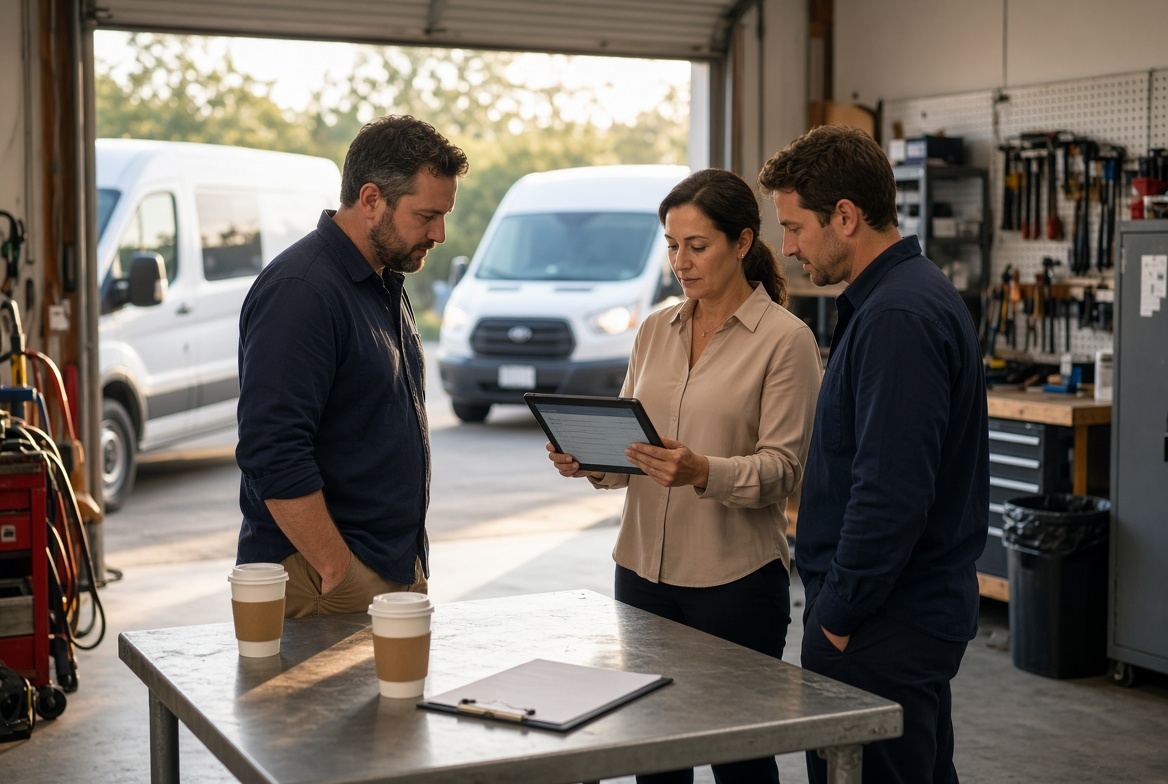
A 10-Minute Huddle Saves Your Afternoon Route
Most messy afternoons did not start at lunch. They started at 7 a.m., when two trucks rolled out with half the story.
A 10-minute huddle will not fix a broken business. It will stop the cheap mistakes that burn a stop, a tank of gas, and a customer who already took time off work.
The day is lost before the first driveway
The office thinks the route is set. The tech thinks the first stop is a simple swap. The customer thinks someone is coming between 8 and 10 with the right part.
Then the gate code is missing. The fixture on the truck is the wrong finish. The second stop is across the bay from the first. By 11:40 the office is on the phone rewriting the afternoon.
That is not bad luck. That is a morning with no shared picture of the work.
A huddle is not a meeting
If it needs slides, it is too long. If only the owner talks, it is a speech. If it happens "when everyone is ready," it will slide to 8:15 and eat the first arrival window.
Keep it standing. Keep it to ten minutes. Keep it tied to today's jobs, not last month's feelings.
The point is simple. Every person who will touch a job today should hear the same facts before the engines start.
The 10-minute agenda
Use the same order every morning. Do not improvise. Improvising is how you spend eighteen minutes on the first job and skip the third.
- Yesterday leftovers. What is still open, who owns it, and whether it belongs on today's route.
- Today's sequence. Read the stops in order, not as a pile. Name the city and the arrival window for each one.
- Access and people. Gate codes, pets, HOA rules, locked boxes, who will be home, who will not.
- Parts and tools. What must already be on the truck. What is still at the shop. What would kill the first hour if it is missing.
- Money and scope. Quoted price, what is included, what is not, and the rule if the customer asks for extra work.
- The one risk. For each job, name the thing most likely to blow the window. Then move on.
If a job cannot survive that list, it is not ready to leave the shop. Park it and call the customer before you burn the slot.
How this looked for a Pinellas plumbing crew
A two-truck plumber in Largo started most days the same way. The owner texted addresses from the driveway. Techs left when they felt ready. The office learned about problems when a customer called asking where the truck was.
One Tuesday made the cost obvious. Truck A drove to a condo in Seminole for a cartridge swap. Nobody had the gate code or the unit number. Twenty-five minutes gone. Truck B went to a hall bath in Safety Harbor with a chrome trim kit. The homeowner had approved brushed nickel on Saturday. Wrong part, wasted stop, a promise to return Thursday.
They did not buy software that week. They added a 7:20 huddle at the shop table.
The office read six jobs out loud. The Seminole stop had the gate code written on the card. The Safety Harbor stop had a photo of the approved trim and a note that the kit was on Truck B. The owner moved a Dunedin add-on to Wednesday because it sat on the wrong side of the bridges for the rest of the route.
That Tuesday still had a hard job. It did not have a pretend morning.
What belongs on the job card before you huddle
A huddle cannot invent facts. It can only surface them. If the card is empty, you will spend the ten minutes hunting.
Each job should show the same fields, even if the work is small:
- Customer name, mobile number, and city
- Arrival window the customer actually heard
- Address plus access notes in plain words
- The promised scope and the quoted range
- Parts staged, parts missing, parts the customer was told to buy
- Photos or a one-line history if you have been there before
- The next action if the job cannot finish today
Write the card the night before when you can. Morning is for exceptions, not for building the file from scratch.
Seven signs your mornings are already costing you
Score the last five working days. Be honest.
- A tech called the office before 9 a.m. to ask what the first job actually was.
- Someone sat in a driveway waiting on a code, a key, or a "quick question."
- A truck came back to the shop before lunch for a part that should have been loaded.
- Two trucks crossed the same bridge twice because the route was a list, not a path.
- A customer said, "That is not what I was told yesterday."
- The owner spent noon rerouting instead of doing the work only the owner can do.
- A finished morning job still had no photos, no notes, and no clear next step.
Three or more yes answers means the afternoon is paying for a sloppy start. A longer standup will not help. A tighter card and a fixed clock will.
Keep it short when the shop gets louder
Two trucks can huddle at one table. Four trucks need a tighter script or the clock dies.
Give one person the list. That person reads. Techs speak only to correct a fact or flag a missing part. Save coaching for a different block. The huddle is for today's route, not for training a new hire on how you price water heaters.
If a tech is already on an early emergency, do not wait. Text that tech the card for their first two stops and huddle with the rest. A missing person is not a reason to skip the picture for everyone else.
End on time even if the last job feels unfinished. Anything that still needs a decision gets a named owner and a call before 8 a.m. The huddle is over. The work is not.
What changes after two weeks
The first week feels stiff. People roll their eyes. Someone will try to turn item four into a parts lecture.
Hold the format. After two weeks you should see fewer 8 a.m. "what is this job" texts. You should see fewer shop runs before lunch. You should hear fewer customers repeating the same story to a second person who did not get the first version.
You should also see the real problems more clearly. If the same access note is missing three days in a row, intake is broken. If parts are always the risk, staging is broken. The huddle does not hide those leaks. It puts them on the table while you can still fix the day.
A focused system makes this easy to keep. When jobs live in one place, with a booking flow that captures the window, the scope, and the access note, the huddle is just reading the truth out loud. That is a better use of ten minutes than rebuilding the afternoon from memory.
Are the calls getting away from you?
I work with Tampa HVAC and plumbing companies that already run at least 3 trucks. Call or text me.